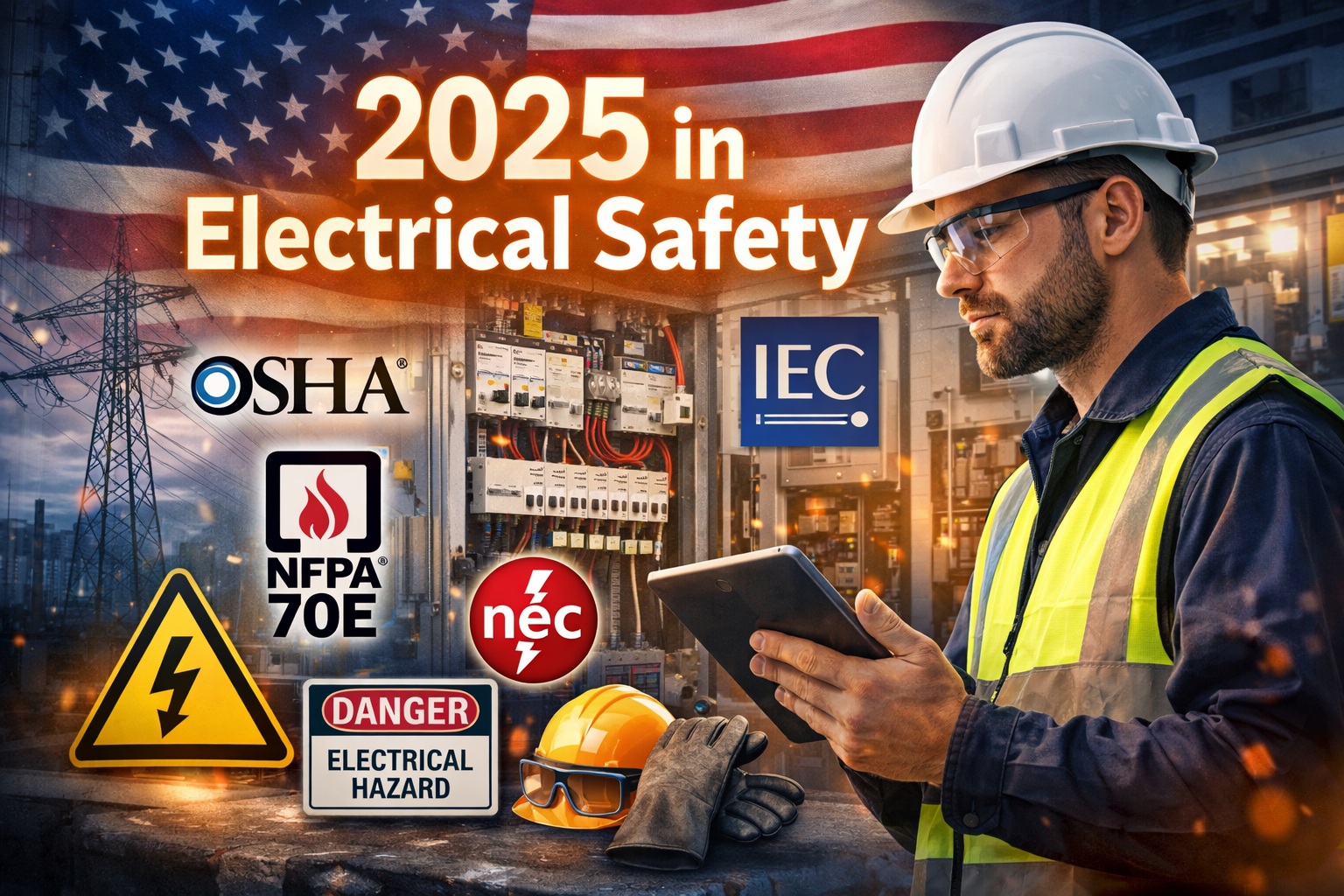
2025 in Electrical Safety: What changed in the United States and Overseas?
Welcome to our comprehensive year-in-review on electrical safety compliance topics, where we unpack the most significant shifts in standards, enforcement, implementation, and global trends shaping the electrical engineering compliance industry in 2025.
This year brought major developments in regulatory priorities, evolving national and international codes, technology-influenced best practices, and new expectations for both facilities and consultants navigating complex compliance landscapes.
In this summary of notable 2025 events and changes, we discuss key changes in the United States, including OSHA emphasis shifts, code updates, and compliance implementation challenges; and conclude with an international perspective on the movements affecting global electrical safety.
OSHA Electrical Safety Enforcement and Regulatory Shifts
One of the defining trends of 2025 was a renewed focus by the Occupational Safety and Health Administration on how facilities manage electrical hazards. OSHA expanded its view on risk areas and updated its guidance on arc flash hazards, emphasizing that even work at lower voltages such as 120 V carries significant risk and must be treated accordingly in workplace procedures and training. This shift reflects a broader reorientation toward risk-based enforcement and aligns with updated expectations for documented hazard analysis and protective measures.
OSHA continued to elevate the importance of documentation, recordkeeping, and proof of conformity in electrical safety enforcement actions. Facilities saw increased scrutiny on lockout/tagout programs, incident-energy analysis records, labeled equipment, and evidence of procedural compliance. What once might have been considered secondary paperwork has now become a focal point in inspections and citations.
This trend has far-reaching implications for how companies implement their internal safety programs. Consultants and internal compliance teams alike must ensure that electrical safety compliance is not just nominally addressed, but rigorously documented, auditable, and clearly reflected in training, procedures, and operational records.
National Electrical Code Adoption Variations and Challenges
The National Electrical Code (NEC) remained a cornerstone of safe electrical installation practice in the United States. What made 2025 notable, however, was the continued patchwork nature of adoption across the country. As of late 2025, nearly half the states had adopted the 2023 NEC, while others remained on prior editions, including the 2020, 2017, and in some cases even older versions. This staggered adoption continued to create challenges for engineers, contractors, and compliance teams who must interpret and apply differing code editions depending on jurisdiction.
This variation underscores several realities of electrical safety compliance in the U.S. First, it remains critical to verify the exact code edition adopted by the local authority having jurisdiction before designing, installing, or upgrading systems. Second, for organizations operating in multiple states or facilities, harmonizing installation practices with the most stringent practical code version has become a de facto strategy for minimizing risk and avoiding costly revisions.
The NEC’s role in shaping electrical safety compliance cannot be overstated. Its influence is felt from residential wiring methods to commercial renewable energy integration and advanced load management requirements. While the debate over specific revisions continues, NEC adherence remains the benchmark for safe, reliable electrical infrastructure.
NFPA Standards Evolution and Practice Impacts
2025 saw continued implementation of the 2024 NFPA 70E edition, which introduced elements such as point-of-work verification and clarified expectations around voltage absence testing. The new emphasis challenged long-standing practices that assumed panel doors alone provided safety assurance, instead requiring verifiable confirmation that circuits were de-energized at every work location before beginning tasks.
In parallel, NFPA 70B made a transition toward more formalized maintenance requirements. Having moved from a recommended practice to a recognized standard, NFPA 70B now has significant implications for facilities that must not only maintain preventive maintenance programs, but document them in line with broader electrical safety compliance expectations.
The combined influence of NFPA standards and OSHA enforcement means that safety programs must weave together installation codes, maintenance practices, hazard analysis, and real-time operational records. Companies that fail to integrate these elements risk gaps in compliance and increased exposure to incidents and penalties.
Technology and Tools Supporting Compliance
Another noteworthy trend in 2025 was the mainstreaming of technology that supports safer inspection and maintenance practices. Tools such as infrared windows and advanced diagnostic ports facilitated safer, closed-panel inspections that dramatically reduce worker exposure to energized components. Such tools are increasingly considered part of modern electrical safety compliance strategies rather than optional upgrades.
Condition-based monitoring, predictive analytics, and digital record-keeping platforms gained traction throughout the year. These technologies allow organizations to move beyond reactive inspection cycles and toward proactive hazard identification and mitigation. Smart, connected sensors provide continuous insight into equipment behavior, which supports immediate detection of anomalies that could otherwise lead to safety incidents.
These practices are reshaping how electrical safety compliance is operationalized on the ground. Rather than documenting inspections after the fact, modern compliance programs can automatically log, timestamp, and retain inspection results, linking them directly to specific assets and technicians. This level of traceability elevates compliance from a retrospective exercise to an ongoing, auditable process.
Consulting and Corporate Preparedness
Electrical safety consulting firms played a more central role in 2025 than in prior years. With regulators emphasizing documentation and cross-standard integration, clients turned to consultants for strategies that bridge gaps between OSHA standards, NFPA codes, and practical facility operations. Field evaluation services, which verify non-listed or modified equipment against applicable standards, have become essential for manufacturers and facilities seeking to demonstrate compliance to authorities having jurisdiction.
Consultants are also increasingly called upon to advise on compliance strategy in a broader risk context, including cybersecurity considerations that intersect with electrical safety in modern industrial control systems. Embedded network connectivity in control panels and distributed systems requires assessment of both physical and digital hazards, making electrical safety compliance a multidimensional practice.
International Developments in Electrical Safety Compliance
While the majority of 2025’s activity centered on the United States, international standardization and code updates also influenced global compliance strategies. The International Electrotechnical Commission continued its work on harmonizing standards such as IEC 60364 for low-voltage installations and committee efforts related to control systems in household and industrial environments.
In many regions outside the U.S., electrical safety compliance is rooted in IEC standards or regional equivalents such as European EN standards and the UK’s wiring regulations derived from them. Manufacturers seeking global market access must navigate these frameworks and align their products and installation practices accordingly.
Countries in Asia and Europe are increasingly focusing on updated documentation requirements, risk assessment protocols, and integration of smart grid technologies that demand new compliance considerations. For example, updated international standards released late in 2025 addressed energy efficiency benchmarks, motor system performance, and safety expectations for power systems used across varied infrastructure sectors.
These developments emphasize that electrical safety compliance is not confined to a single regulatory regime but is influenced by a mosaic of global standards that continue to evolve in response to technological advances and safety research.
Looking Forward Into 2026
2025 was a landmark year in electrical safety compliance that challenged organizations to rethink how they approach regulation, risk, and technology adoption. The interplay between OSHA enforcement, NFPA standards, NEC adoption variation, and global standardization efforts revealed the need for holistic, documented, and forward-looking compliance programs.
Whether you are managing a facility, advising clients, or designing electrical systems, the lessons of 2025 underscore the importance of integrating safety strategy with operational and technological innovation. As we move into 2026, the momentum behind proactive, data-driven, and globally aware electrical safety compliance will only continue to grow.
Until next time keep studying the codes, keep engaging with emerging tools, and keep advancing your compliance practices to protect people and property in an increasingly complex electrical ecosystem.