Ask Lewis Bass: Does Adding a Robot Change an Existing SEMI S2 Evaluation?
From the Desk of Lewis Bass
Welcome back to “Ask Lewis Bass,” our ongoing series where we answer real-world questions from engineers, panel builders, OEMs, and compliance teams working through the challenges of industrial electrical safety and equipment compliance. This week we’re tackling a question we receive surprisingly often from companies building custom industrial control panels.
Question:
We have a semiconductor process tool that previously completed a SEMI S2 evaluation. The tool was originally designed for manual wafer carrier loading, but our customer now wants to connect a third-party mobile robot that will deliver and remove carriers automatically.
The robot has its own safety documentation, and we are not changing the process chamber or chemical system inside the tool. Does the original SEMI S2 report still apply, or does the entire tool need to be evaluated again?
– Erica M.
Lewis Bass:
Hi Erica,
This is exactly the kind of modification that can look simple on a project schedule and become much more interesting during the safety review.
The short answer is that your original report may still provide a useful foundation, but it probably does not cover the complete automated configuration.
A SEMI S2 evaluation applies to the equipment configuration and operating conditions that were actually assessed. Your process chamber may be unchanged. Your chemical system may be unchanged. Even the robot may arrive with an excellent safety package of its own. But once the robot and process tool begin working together, you have created a new interface, and that interface can introduce hazards that neither original evaluation considered independently.
In other words, two individually evaluated machines do not automatically become one safely integrated system.
So, what changed?
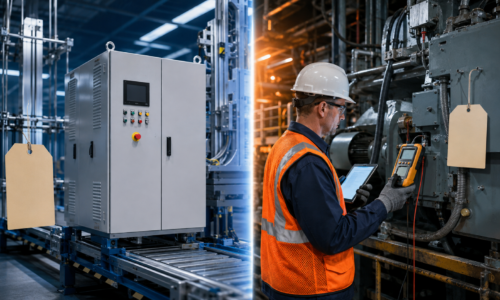
The loading task is no longer being performed by a person who can see a misplaced carrier, notice an obstruction, or step away when something does not look right. The robot and process tool must now exchange commands, confirm conditions, handle faults, and reach a safe state when communication fails.
The new configuration may need review for:
- Crushing, pinching, and impact hazards within the robot’s travel and transfer areas
- Unexpected motion while an operator is loading, servicing, or clearing a fault
- The behavior of both systems when communications are interrupted
- Conflicting emergency stop or protective-stop functions
- Access to the tool’s emergency controls after the robot and docking hardware are installed
- Carrier misalignment, dropped material, and recovery from an incomplete transfer
- New maintenance tasks created by the automated interface
- Changes to guarding, warning labels, operating instructions, and training
That does not necessarily mean starting the entire SEMI S2 evaluation from a blank page.
If the original tool remains substantially unchanged, an experienced evaluator can often preserve the applicable portions of the existing report and concentrate on the modification. The project may be handled as a focused reassessment or an addendum, depending on the age and quality of the original documentation, the edition used, the extent of the changes, and the customer’s requirements.
The key is to define the boundary correctly.
If the robot supplier evaluates only the robot, and the tool supplier evaluates only the process tool, the hazards in the space between them can become everyone’s blind spot. Someone must assess the combined operation, including foreseeable faults and human interaction with the integrated system.
For this type of SEMI S2 evaluation, we would normally begin by reviewing:
- The original SEMI S2 report and open items, if any
- The robot manufacturer’s safety documentation and intended-use limitations
- Revised layouts, schematics, interface-control documents, and operating sequences
- Safety interlock and emergency-stop behavior for both systems
- The risk assessment for normal operation, setup, maintenance, and fault recovery
- Any new ergonomic or access issues created by the robot, dock, fencing, or sensors
We would then identify which conclusions in the original report remain valid, which require confirmation, and which new hazards need testing or corrective action. The goal is not to repeat work simply for the sake of repeating it. The goal is to make sure the report accurately represents the equipment the customer will actually operate.
One practical tip: involve the evaluator before the robot interface is finalized. It is much easier to address an emergency-stop conflict, blind zone, or unsafe recovery sequence in the design documents than after the equipment has been installed inside a cleanroom.
Your original SEMI S2 report is not useless, and the unchanged portions of the tool do not automatically lose their value. But the automated interface is a meaningful change that deserves its own documented review. A targeted SEMI S2 evaluation can help you reuse valid prior work while closing the safety gaps created by the new robot integration.
Do you have a question for Lewis Bass?
If you have a question you would like to ask our engineering team about, and don’t mind it being featured in one of our upcoming blog posts, please contact us and reference “Ask Lewis Bass” in the message body.
Include any helpful context along with the question you’d like us to answer for you. All company contact information except for a first name, unless already anonymous on receipt, is anonymized for privacy reasons.