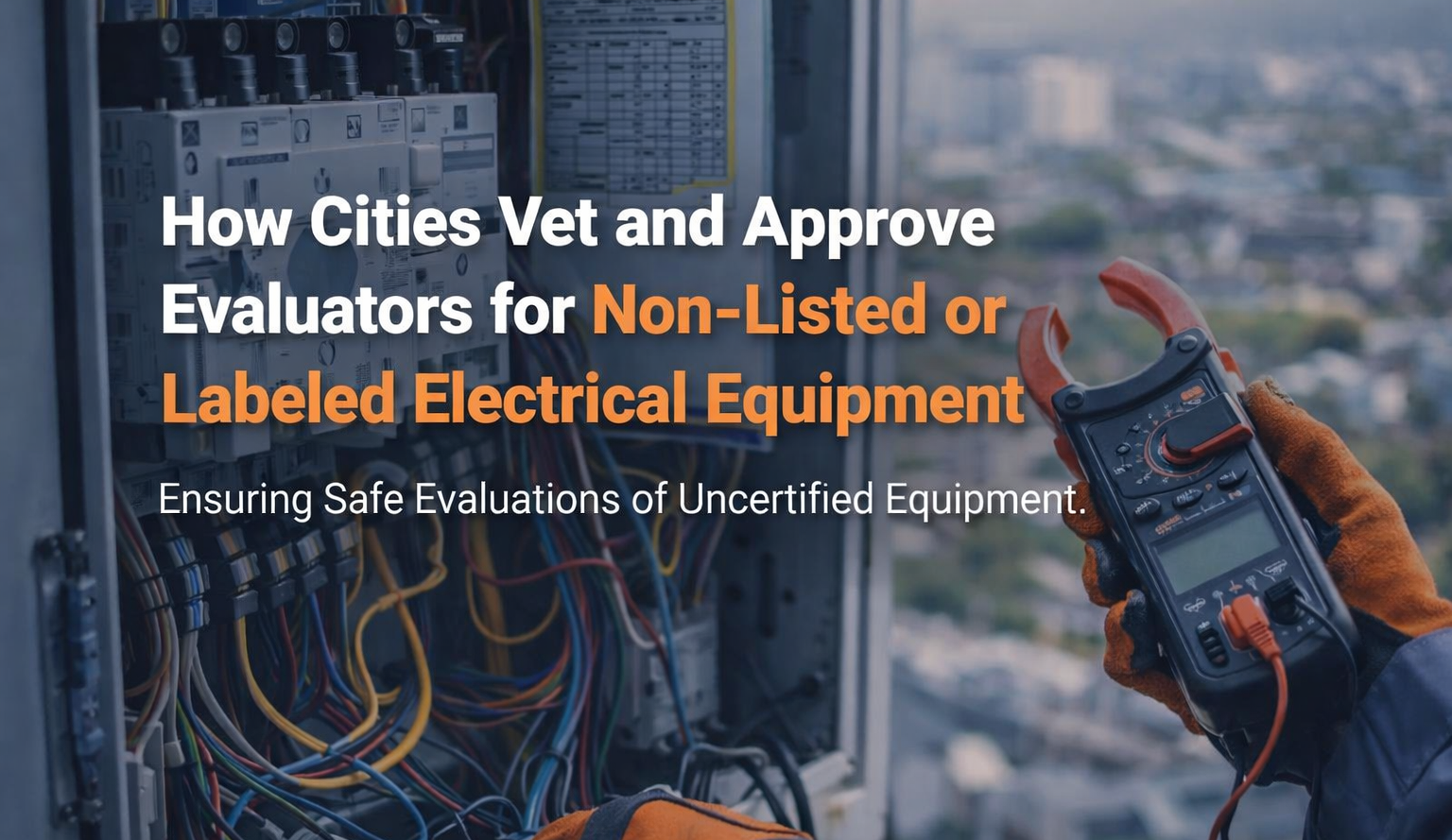
How Cities Vet and Approve Third-Party Evaluators for Unlisted Electrical Equipment
If you have ever installed a piece of industrial, laboratory, or custom-built equipment and been told by an inspector that it needs “third-party approval,” you are not alone.
This moment often happens when a machine arrives onsite without a familiar UL or CSA mark. At that point, many owners and contractors ask the same question: How does a city decide who is allowed to evaluate this equipment in the first place?
The answer is more structured and intentional than most people realize. Cities and counties do not simply accept any company that claims to perform electrical evaluations. Instead, they deploy formal programs to vet, approve, and monitor third-party agencies that are qualified to evaluate non-listed or labeled equipment, all with one goal in mind: maintaining electrical safety within their jurisdiction.
To understand how this works, it helps to look at how the City of Sunnyvale approaches this issue.
Why Cities Care About Listing and Labeling
Electrical codes across the United States start from a simple baseline: electrical equipment should be listed and labeled by a Nationally Recognized Testing Laboratory. This listing confirms that the product has been evaluated against applicable safety standards before it ever reaches a job site.
But the real world is messy. Custom machines, research equipment, prototypes, imported systems, and modified assemblies regularly fall outside the scope of standard listings. That is where non-listed or labeled equipment enters the picture. Rather than banning this equipment outright, building departments rely on a controlled alternative: third-party field evaluations.
This is not a loophole. It is a deliberate process written into the electrical code and administered locally by the Authority Having Jurisdiction.
The City’s Role: Setting the Rules of the Road
When a city creates a program to recognize third-party electrical testing agencies, it is effectively saying, “If equipment is not listed, we will allow it only if it is evaluated by organizations we trust.”
In the City of Sunnyvale’s case, the building division clearly states that unlisted equipment must be evaluated and labeled by a third-party agency that the city itself recognizes. The building official retains full authority to require these evaluations, review the reports, and accept or reject the results.
This approach ensures consistency. Inspectors in the field are not left guessing whether an evaluation is credible. Everyone involved knows which agencies meet the city’s expectations before a project ever reaches final inspection.
How a City Decides Who Is “Qualified”
Recognition is not automatic. Third-party agencies must apply and demonstrate competence in a very specific way. Cities typically anchor this process to nationally adopted standards, most commonly NFPA 790, which defines competency requirements for field evaluation bodies.
Application packages usually include formal documentation, management disclosures, evaluator qualifications, and examples of the labels that will be affixed to approved equipment. Agencies must also agree to notify the city if key personnel or management changes occur. In other words, approval is based on systems and accountability, not just resumes.
This vetting process protects the city by ensuring that only organizations with proven technical rigor, independence, and traceability are allowed to perform evaluations of non-listed or labeled equipment.
Time Limits, Renewals, and Oversight
Approval is not forever. Cities typically grant recognition for a defined period, often three years. Renewal requires re-submission of application materials and allows the building official to reassess whether an agency still meets the jurisdiction’s expectations.
Just as importantly, the city retains the authority to remove agencies from its recognized list. If reports are consistently deficient, if evaluations do not align with adopted codes, or if administrative requirements are not met, recognition can be revoked. This ongoing oversight is what keeps the system credible and effective.
What This Means for Equipment Owners and Contractors
For owners, manufacturers, and installers, these programs provide clarity. If you are dealing with non-listed or labeled equipment, you can consult the city’s published list of recognized third-party agencies and engage one with confidence that their work will be accepted by the city when it comes time for permit sign-off.
For inspectors, the benefit is even clearer. Rather than evaluating unfamiliar equipment from scratch, they receive structured reports prepared under recognized standards, complete with documented findings and corrective actions.
For the public, the result is safer installations. These programs ensure that alternative evaluation pathways do not dilute electrical safety standards but instead reinforce them through controlled, transparent processes.
A Quiet but Critical Safety Net
Most people never notice these programs unless a project triggers them. Yet they quietly underpin thousands of approvals every year for custom and specialized equipment. By carefully vetting third-party evaluators, cities create a safety net that balances innovation with accountability.
When done correctly, the process protects everyone involved, from the inspector in the field to the worker operating the machine. And that is ultimately the point. Programs like these ensure that even when equipment falls outside traditional listings, electrical safety remains firmly inside the guardrails.
Understanding how jurisdictions manage non-listed or labeled equipment helps demystify inspections and highlights the thoughtful systems cities use to keep people and facilities safe.
Why Should You Choose Lewis Bass for Your Field Evaluation Project in Sunnyvale?
At Lewis Bass, we go beyond compliance. We partner with your team from the moment a red tag goes up or a permit is pulled, helping identify whether your equipment falls into the complex category and preparing the right path forward.
Whether you’re dealing with a foreign-built automation cell, a custom power distribution cabinet, or any piece of electrical gear that doesn’t have an NRTL label, we’re here to help you get it approved, inspected, and operational with minimal hassle and maximum efficiency.
If you’ve got Non-Listed Electrical Equipment in Sunnyvale or anywhere in California, get in touch with us today. We know the codes, we know the AHJs, and we know how to get your project moving again if you’ve been blocked by a city inspector. In most cases, we’re also faster and more affordable than trying to route the equipment through a traditional NRTL listing process which may not even be viable for one-off or specialized systems.